


Why Some Farmers Stay Busy but Never Become Profitable
- Malik Miller

- 1 day ago
- 9 min read
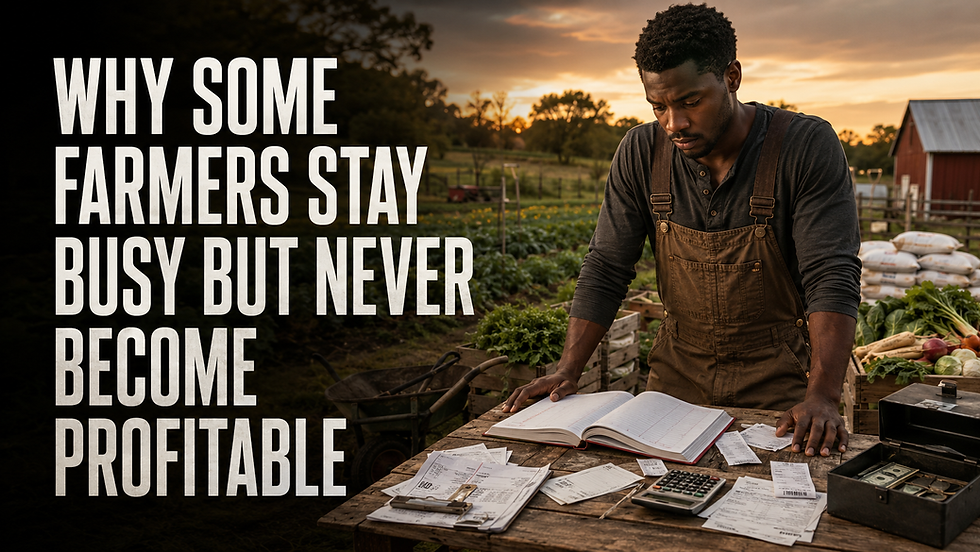
A dangerous belief in agriculture is that working harder automatically means the farm is doing better.
A farmer can wake up before sunrise, work until dark, feed animals, repair fences, plant crops, answer customers, haul products, and repeat the entire process the next day—and still lose money.
That does not mean the farmer is lazy or incapable. It means effort and profitability are not the same thing.
Hard work keeps a farm moving. Good decisions make it profitable.
Being Busy Can Hide a Broken Business Model
Constant activity can create the feeling of progress. There is always another task to complete, so it becomes easy to assume the operation is growing.
But activity is not the same as advancement.
If a farmer produces products customers do not want, sells them for less than they cost to produce, or spends all day on low-value work, being busier only increases the loss.
A farmer must occasionally step away from the daily work and ask:
Which products are actually making money?
Which enterprises consume the most time?
What does it cost to produce each unit?
Which customers return consistently?
Where is money being lost?
If those questions cannot be answered, the farm may be operating on effort instead of information.
They Know Their Production—but Not Their Numbers
Many farmers can tell you how many animals they own, how many acres they planted, or how many pounds they harvested. Fewer can tell you their cost of production, profit margin, or break-even price.
Revenue alone does not prove profitability.
A farm can generate $100,000 in sales and still lose money if it costs $110,000 to operate. A smaller farm earning $50,000 may be healthier if it controls expenses and keeps a reasonable profit.
Farmers should track:
Total revenue
Direct production costs
Overhead expenses
Labor, including the owner’s time
Profit by enterprise
Cash available for upcoming obligations
Your bank balance tells you what is available today. Your records tell you whether the business is working.
They Price From Emotion Instead of Cost
Some farmers are afraid to charge what their products are worth. They worry customers will complain, compare them with grocery-store prices, or buy from someone else.
As a result, they price products based on what feels affordable rather than what the farm needs to survive.
Your price must account for seed, feed, fertilizer, packaging, fuel, processing, utilities, transportation, losses, marketing, labor, and profit.
If those costs are not built into the price, the farmer is personally subsidizing every customer.
Being the cheapest producer is not a victory if you cannot afford to remain in business.
They Produce Before Finding the Customer
Growing something successfully does not guarantee that it will sell.
Many beginning farmers decide what to raise, buy equipment, build infrastructure, and produce the product before having serious conversations with buyers.
When harvest arrives, they are forced to accept low prices, scramble for customers, or watch the product go to waste.
Profitable farmers study demand before expanding production.
They ask restaurants, grocers, distributors, farmers-market shoppers, and local families what they buy, how much they need, when they need it, and what standards must be met.
Your first customer should influence your first crop. Your market should help shape your production plan.
They Confuse Expansion With Growth
More acres, livestock, equipment, greenhouses, and employees may make a farm larger, but they do not automatically make it stronger.
Expansion increases both opportunity and risk. Every new asset can introduce another payment, repair, labor requirement, or management problem.
Real growth improves the farm’s financial position. That may mean producing more, but it can also mean reducing waste, raising prices, improving efficiency, selling directly to customers, or eliminating an unprofitable enterprise.
Before expanding, ask:
Is demand already greater than our capacity?
Is the current operation profitable?
Will this investment increase profit or only increase workload?
How long will it take for the investment to pay for itself?
Do not scale confusion. Prove the model first, then expand it.
They Try to Do Everything Themselves
Farmers are naturally resourceful, but independence can become a bottleneck.
If the owner handles production, repairs, bookkeeping, marketing, deliveries, customer service, and every administrative task, the farm’s growth becomes limited by one person’s time and energy.
Delegation does not always mean hiring a large team. It may mean using an accountant, contracting seasonal labor, automating invoices, scheduling marketing content, sharing equipment, or partnering with another producer for distribution.
The farmer’s time should be directed toward work that needs the farmer’s judgment—not every task that appears on the farm.
They Never Pay Themselves
Some farms appear profitable only because the owner’s labor is treated as free.
If a farmer works 60 hours a week and the business cannot compensate that labor, the operation may be surviving because of personal sacrifice—not because the model is financially sound.
The owner may choose to reinvest income during the early years, but labor still has value and should be recorded. Otherwise, the numbers create a false picture of profitability.
A business that cannot eventually pay its owner has not yet created a sustainable job.
They Chase Grants Instead of Building Revenue
Grants can help fund infrastructure, conservation, research, processing, marketing, and expansion. They can be valuable tools—but they are not substitutes for customers.
A grant may pay for a greenhouse, but it will not guarantee that anyone buys what grows inside it. It may fund equipment, but it will not repair weak pricing or poor management.
Funding should strengthen a workable business model. It should not be expected to rescue one that has never been tested.
The goal is not simply to win money. The goal is to build an operation capable of generating money after the funding ends.
Profitability Requires Time Away From the Work
Farmers often feel guilty when they are not physically producing. But reviewing financials, speaking with buyers, planning production, evaluating prices, and improving systems are also farm work.
At least once a month, review the operation as a business owner—not only as a producer.
Identify what made money, what lost money, what needs to change, and where your time created the greatest return. Then make decisions using the information you collected.
Busy farmers complete tasks. Profitable farmers make sure those tasks support a clear financial goal.
Hard Work Needs Direction
Agriculture will always require effort. There are no shortcuts around responsibility, patience, weather, livestock care, and the realities of production.
But hard work without records, pricing, customers, systems, and strategy can become an expensive cycle.
The goal is not to work less simply for the sake of working less. The goal is to make your work produce a measurable return.
You do not need another 12-hour day filled with random activity. You need to know which activities move the farm forward—and have the discipline to stop doing the ones that do not.
Your farm should eventually do more than keep you busy.
It should pay you.
Are you working hard on your farm but unsure whether the numbers make sense? Book a Farm Readiness Strategy Call with Farmer Millz to evaluate your business model, costs, market, funding options, and next steps. There is a dangerous belief in agriculture that working harder automatically means the farm is doing better.
A farmer can wake up before sunrise, work until dark, feed animals, repair fences, plant crops, answer customers, haul products, and repeat the entire process the next day—and still lose money.
That does not mean the farmer is lazy or incapable. It means effort and profitability are not the same thing.
Hard work keeps a farm moving. Good decisions make it profitable.
Being Busy Can Hide a Broken Business Model
Constant activity can create the feeling of progress. There is always another task to complete, so it becomes easy to assume the operation is growing.
But activity is not the same as advancement.
If a farmer produces products customers do not want, sells them for less than they cost to produce, or spends all day on low-value work, being busier only increases the loss.
A farmer must occasionally step away from the daily work and ask:
Which products are actually making money?
Which enterprises consume the most time?
What does it cost to produce each unit?
Which customers return consistently?
Where is money being lost?
If those questions cannot be answered, the farm may be operating on effort instead of information.
They Know Their Production—but Not Their Numbers
Many farmers can tell you how many animals they own, how many acres they planted, or how many pounds they harvested. Fewer can tell you their cost of production, profit margin, or break-even price.
Revenue alone does not prove profitability.
A farm can generate $100,000 in sales and still lose money if it costs $110,000 to operate. A smaller farm earning $50,000 may be healthier if it controls expenses and keeps a reasonable profit.
Farmers should track:
Total revenue
Direct production costs
Overhead expenses
Labor, including the owner’s time
Profit by enterprise
Cash available for upcoming obligations
Your bank balance tells you what is available today. Your records tell you whether the business is working.
They Price From Emotion Instead of Cost
Some farmers are afraid to charge what their products are worth. They worry customers will complain, compare them with grocery-store prices, or buy from someone else.
As a result, they price products based on what feels affordable rather than what the farm needs to survive.
Your price must account for seed, feed, fertilizer, packaging, fuel, processing, utilities, transportation, losses, marketing, labor, and profit.
If those costs are not built into the price, the farmer is personally subsidizing every customer.
Being the cheapest producer is not a victory if you cannot afford to remain in business.
They Produce Before Finding the Customer
Growing something successfully does not guarantee that it will sell.
Many beginning farmers decide what they want to raise, purchase equipment, build infrastructure, and produce the product before having serious conversations with buyers.
When harvest arrives, they are forced to accept low prices, scramble for customers, or watch the product go to waste.
Profitable farmers study demand before expanding production.
They ask restaurants, grocers, distributors, farmers-market shoppers, and local families what they buy, how much they need, when they need it, and what standards must be met.
Your first customer should influence your first crop. Your market should help shape your production plan.
They Confuse Expansion With Growth
More acres, livestock, equipment, greenhouses, and employees may make a farm larger, but they do not automatically make it stronger.
Expansion increases both opportunity and risk. Every new asset can introduce another payment, repair, labor requirement, or management problem.
Real growth improves the farm’s financial position. That may mean producing more, but it can also mean reducing waste, raising prices, improving efficiency, selling directly to customers, or eliminating an unprofitable enterprise.
Before expanding, ask:
Is demand already greater than our capacity?
Is the current operation profitable?
Will this investment increase profit or only increase workload?
How long will it take for the investment to pay for itself?
Do not scale confusion. Prove the model first, then expand it.
They Try to Do Everything Themselves
Farmers are naturally resourceful, but independence can become a bottleneck.
If the owner handles production, repairs, bookkeeping, marketing, deliveries, customer service, and every administrative task, the farm’s growth becomes limited by one person’s time and energy.
Delegation does not always mean hiring a large team. It may mean using an accountant, contracting seasonal labor, automating invoices, scheduling marketing content, sharing equipment, or partnering with another producer for distribution.
The farmer’s time should be directed toward work that needs the farmer’s judgment—not every task that appears on the farm.
They Never Pay Themselves
Some farms appear profitable only because the owner’s labor is treated as free.
If a farmer works 60 hours a week and the business cannot compensate that labor, the operation may be surviving because of personal sacrifice—not because the model is financially sound.
The owner may choose to reinvest income during the early years, but labor still has value and should be recorded. Otherwise, the numbers create a false picture of profitability.
A business that cannot eventually pay its owner has not yet created a sustainable job.
They Chase Grants Instead of Building Revenue
Grants can help fund infrastructure, conservation, research, processing, marketing, and expansion. They can be valuable tools—but they are not substitutes for customers.
A grant may pay for a greenhouse, but it will not guarantee that anyone buys what grows inside it. It may fund equipment, but it will not repair weak pricing or poor management.
Funding should strengthen a workable business model. It should not be expected to rescue one that has never been tested.
The goal is not simply to win money. The goal is to build an operation capable of generating money after the funding ends.
Profitability Requires Time Away From the Work
Farmers often feel guilty when they are not physically producing. But reviewing financials, speaking with buyers, planning production, evaluating prices, and improving systems are also farm work.
At least once a month, review the operation as a business owner—not only as a producer.
Identify what made money, what lost money, what needs to change, and where your time created the greatest return. Then make decisions using the information you collected.
Busy farmers complete tasks. Profitable farmers make sure those tasks support a clear financial goal.
Hard Work Needs Direction
Agriculture will always require effort. There are no shortcuts around responsibility, patience, weather, livestock care, and the realities of production.
But hard work without records, pricing, customers, systems, and strategy can become an expensive cycle.
The goal is not to work less simply for the sake of working less. The goal is to make your work produce a measurable return.
You do not need another 12-hour day filled with random activity. You need to know which activities move the farm forward—and have the discipline to stop doing the ones that do not.
Your farm should eventually do more than keep you busy.
It should pay you.
Are you working hard on your farm but unsure whether the numbers make sense? Book a Farm Readiness Strategy Call with Farmer Millz to evaluate your business model, costs, market, funding options, and next steps.


Comments